Daniel Dauhajre
UCLA Department of Atmospheric and Oceanic Sciences
ddauhajre@atmos.ucla.edu
Research
Continental shelf circulation patterns are conventionally described by tides, surface gravity waves, local wind driving, coastal trapped waves, internal waves, shelf-break fronts, river inflow and buoyant currents. However, downscaling through grid-nesting in regional ocean models and informed nearshore observational campaigns have led to a finer-scale view of the coastal ocean. From these new realizations, it is clear that there is more to the continental shelf than the previously mentioned classical paradigms.
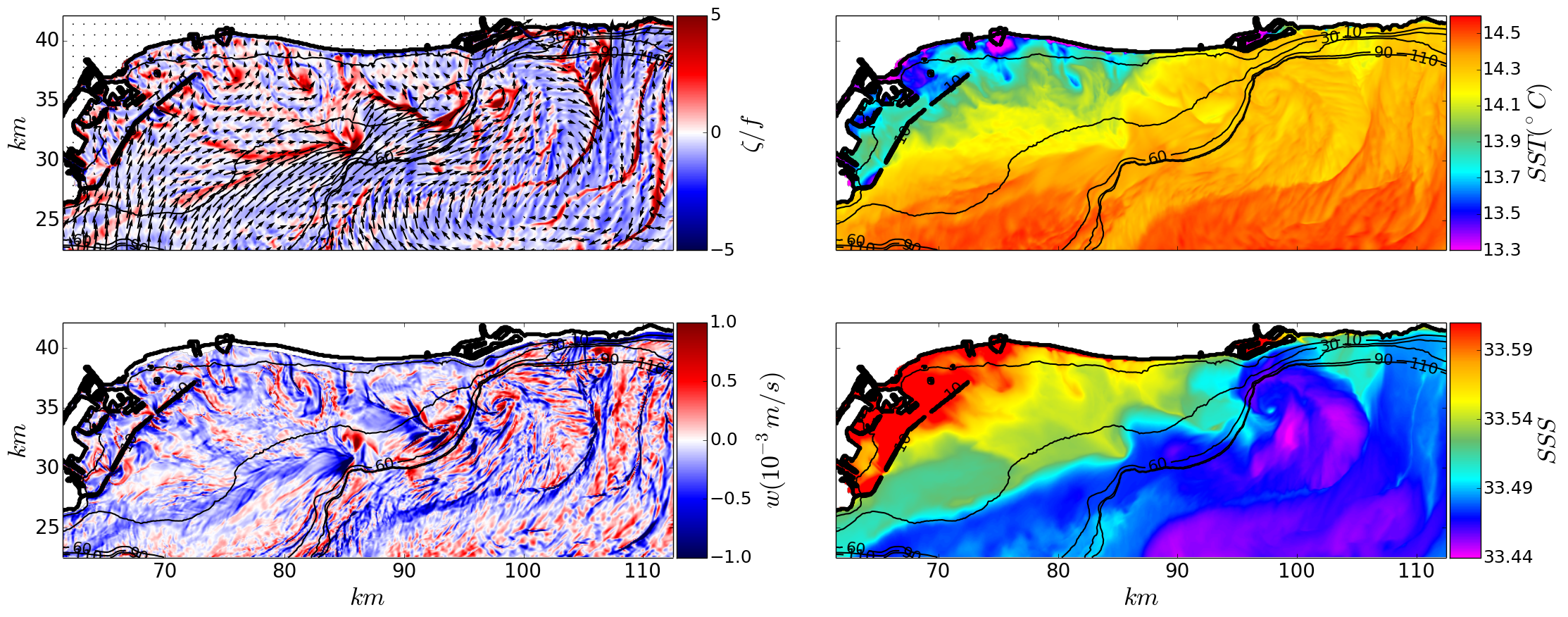
The figure above is a snapshot from a ROMS (Regional Oceanic Modeling System) simulation with 75 m horizontal resolution of San Pedro Bay, CA. The snapshot shows the Southern California continental shelf littered with the preferred spatial patterns of submesoscale turbulence: fronts, filaments, and vortices on spatial scales of 0.1 - 1 km. These coherent structures are characterized by strong cyclonic vorticity (top left), strong downwelling (bottom left), and extreme lateral density gradients indicated by the sea surface temperature (top right) and sea surface salinity (bottom right) fields. Strong surface convergence causes the strong downwelling at the center of these structures; fronts and filaments on the shelf can induce lateral organization of surface material on hour to daily time-scales. My research focuses on characterizing submesoscale variability on the shelf, uncovering the fundamental dynamics at play through idealized models, and diagnosing the degree to which these currents control the fate and transport of material (e.g., pollution, larvae) in the nearshore ocean.
Publications
Dauhajre, D.P., J.C. McWilliams, & Y. Uchiyama, 2017: Submesoscale Coherent Structures on the Continental Shelf, Submitted. J. Phys. Oceanogr.Dauhajre, D.P., & J.C. McWilliams: Diurnal evolution of submesoscale front and filaments, In Preparation