Increasing the Interoperability of an Earth System
Model:
Atmospheric-Ocean Dynamics and Tracer Transports
NCC4-624
Milestone
D
Final
Report: 1- 30 May 2006
1.
Objective
This CAN
addressed three major thrusts of the ESS Project: 1) to further our understanding
of and ability to predict the dynamic interaction of physical and chemical
processes affecting Earth, 2) to incorporate the use of NASA data, and 3) to
demonstrate interoperability of codes used in the community of Earth Science.
We acted as
early adaptors of the Earth System Modeling Framework (ESMF). Our role consisted of integrating into
this framework the UCLA Earth System Model (ESM) gridded components: 1)
atmospheric general circulation model (AGCM) developed at UCLA, 2) oceanic GCM (OGCM) known as Parallel
Ocean Program (POP) and 3) OGCM developed at the Massachusetts Institute of
Technology (MIT). The ESMF functionality was demonstrated by analyzing the El
Niño prediction capability of the AGCM coupled to the POP and MIT OGCM, in
combination with NASA/JPL ocean data and optimization products.
2. Approach
We followed
a three-tiered approach.
Tier I
consisted of integrating the coupled atmosphere-ocean part of the UCLA (ESM)
into the ESMF. The model and its components are described in Milestone A.
Tier II
addressed the issues of code interoperability by using the ESMF services to
couple the AGCM with either POP or the OGCM developed at the (MIT), and by
performing forecasts of El Niño/Southern Oscillation (ENSO).
Tier III
focused on the impact of NASA data and consisted of comparing ENSO forecasts
made from initial conditions corresponding to the quasi-operational analysis of
the time-evolving ocean circulation produced by the consortium for Estimating
the Circulation and Climate of the Ocean (ECCO) maintained at the Jet
Propulsion Laboratory (JPL). The ECCO product is updated approximately once per
week, is freely available (http://ecco.jpl.nasa.gov). The MIT
OGCM is a component in ECCO’s data assimilation system, while POP is not.
3. Scientific
Accomplishments
The parameterization of planetary
boundary layer (PBL) processes used in the UCLA AGCM was upgraded. The upgrade
improved the simulations in several respects, particularly in the surface
fluxes that play key roles in the coupling between atmosphere and ocean
(Milestone F).
We use the UCLA AGCM coupled with the MIT global OGCM in order to obtain ensemble seasonal hindcasts for the years 1993-2001, which include strong El Niño and La Niña events. We consider two kinds of initial conditions for the OGCM: a) estimates provided by the JPL's Estimating the Circulation and Climate of the Ocean (ECCO) project, and b) fields obtained from a long uncoupled OGCM simulation (with prescribed SST and wind stress from observations) for a period that includes 1993-2001 (ECCO and baseline initial conditions respectively). The hindcasts start from either early March or early June and extend for fifteen months. We found that forecast skill is relatively high in all cases, with higher values for initial conditions in June. Forecast skill is much higher than persistence in the March cases (see Fig. 1). Our results show that initial ocean states can have a significant influence on the skill of seasonal forecasts with a coupled atmosphere-ocean CGM. ECCO initial conditions have smaller, perhaps more realistic, anomalies than the baseline initial conditions. This might be associated with a more realistic climatological thermocline in the ECCO set.
4. Technology
Accomplishments (including progress toward milestones)
The Distributed Data Broker (DDB) developed under Round 2
of this CAN project was upgrade and further developed. This included support for MPI and
shared memory, improve performance, improve diagnostic and error handling,
improve user interface and deliver updated documentation for the Distributed
Data Broker (Milestone I).
The OGCM
POP was upgraded to a near global domain (excluding both polar regions) without
loss of performance compared to E (Milestone G).
The ESMF services
were used to couple the UCLA AGCM and POP, and integrate them into the ESMF
framework (Milestone J). Extensive work was performed with the UCLA AGCM
itself to make it ESMF compliant. The model’s own control code and coupling
routines were removed. To conform to ESMF methodology, entry points were
defined in the model to allow for discrete calls to the initialize, run, and
finalize methods. No functional or performance degradation was found. The code
can still run stand-alone (without ESMF) by setting a flag. Chris Hill and Phil
Jones modified the MIT OGCM and POP, respectively, to be ESMF compliant.
The ESMF functionality was
demonstrated by analyzing the El Niño prediction capability of the UCLA AGCM
coupled to POP and the MIT OGCM, in combination with NASA/JPL ocean data and
optimization products.
5. Point of contact
(name, address, email)
Carlos
R. Mechoso, Professor
University
of California, Los Angeles
Department
of Atmospheric Sciences
7127
Math Sciences Building
405
Hilgard Avenue
Los
Angeles, California 90095-1565
Phone: 310-825-3057
FAX: 310-206-5219
Email: Mechoso@atmos.ucla.edu
www.atmos.ucla.edu/~mechoso
6. Caption for the
graphic
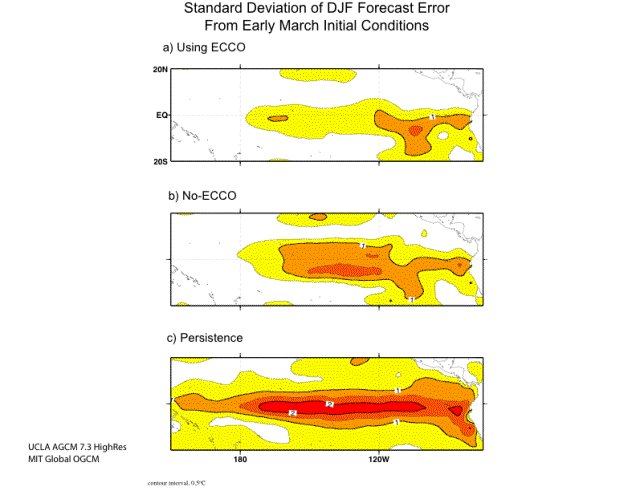
For forecasts initiated in March, those obtained
using initial conditions from the JPL/ECCO project show smaller root mean
square errors in the equatorial Pacific than the forecasts from initial
conditions from the model fields without data assimilation and the persistence
forecasts.
7. List (and abstracts)
of all publications which cite work performed under this CAN
Konor, C. S., Cazes-Boezio, G., A.
Arakawa, and C. R. Mechoso, 2007: A Multi-Layer Bulk PBL
Parameterization for Use in Climate Models: Application to an Atmospheric General
Circulation Model. In preparation.
Cazes-Boezio, G., D. Menemenlis,
and C. R. Mechoso, 2007: Impact of ECCO Ocean State Estimates on the
Initialization of Seasonal Climate Forecasts. In preparation.
Cazes-Boezio, G., D.
Menemenlis, and C. R. Mechoso. Experimental ENSO predictions by the UCLA
atmospheric GCM coupled to the MIT and POP Oceanic GCMs using the Earth System
Modeling Framework (ESMF). In
preparation.
8. List of conference
presentations resulting from work performed under this CAN
Mechoso, C. R.: The UCLA Earth System
Model. Second Annual Conference of
NASA Office of Earth Science and Earth Science Technology Office (ESTO). 11-13
June 2002, Pasadena, California
Earth system modeling at UCLA.
Computers in Atmospheric Sciences 2003 (CAS2K3), 8-11 September 2003, Annecy,
France.
Mechoso, C. R., J. A. Spahr, C. Hill, P.
Jones and D. Menemenlis: Integration of Atmosphere and Ocean General
Circulation Models into the Earth System Modeling Framework . General Assembly
of the European Geosciences Union, 24-29 April 2005, Vienna, Austria.
Cazes-Boezio, G.,
C. S. Konor, C. R. Mechoso, D. Menemenlis, and A. Arakawa: Coupled Simulations Obtained with the
UCLA AGCM with a New PBL Parameterization and the MIT Global OGCM. AMS 17th Conference on
Climate Variability and Change, 13-17 June 2005 Cambridge, Massachusetts.
(see
http://ams.confex.com/ams/Cambridge/techprogram/ programexpanded_281.htm)
Mechoso, C. R.: Integration of a
Coupled Atmosphere-Ocean Model into the ESMF (Earth System Model Framework). Computers
in Atmospheric Sciences 2005 (CAS2K5), 11-14 September 2005, Annecy, France.
DeLuca, C., V. Balaji, A. da Silva,
R. Dunlap, Hill, C., Mark, L., C.
R. Mechoso, D. Middleton, S. Nikonov, S. Rugaber, and M. Suarez: The Earth
System Modeling Framework and Earth System Curator: Software Components as
Building Blocks of Community. Presented by C. DeLuca at the 2006 Joint Assembly
of the American Geophysical Society, 23-26 May 2006, Baltimore, Maryland. See also Eos Trans. AGU, 87(36), Jt. Assem. Suppl., Abstract IN33A-03Eos
Trans. AGU, 87(36), Jt. Assem. Suppl.,
Abstract IN33A-03
9. Lists of all other
media references in which the research was discussed.
The project was highlighted in
the Summer 2005 issue of NASA CISTO News.
10. List of any patents filed or new
technology reports resulting from work under this cooperative agreement.
No patents resulted from work
under this CAN
11.
List of graduate
students or post docs trained; list of advanced degrees awarded and thesis
titles (if available).
Cabriel Cazes-Boezio (Research
Scientist)
Ingo Richter, PhD 2005
Heng Xiao, Advanced to PhD
candidacy, January 2006.